Introduction
These pages summarise much of what has been learned through the Burnett Y-DNA Project. The Project aims to help Burnett descendants discover their Burnett roots. It uses Y-DNA testing to enable them to identify their Burnett family line with scientific certainty and to expand their tree by using information that others in their family line have already discovered. About half of the lines lead back to early Burnett ancestors in Scotland or England; about another half lead back to early Burnett arrivals in the USA, with their earlier origins not yet being identified. Many testers have been able to add multiple new generations, while others have used the results to successfully identify their pre-Colonial origins. We might expect to make further headway on this if we had more testers from the UK.
This research is the result of the time, money, and effort of hundreds of Burnett descendants. Those who shared their DNA, those who spent innumerable hours researching, and those who collaborated are all recognized here as essential to this work. This was written and compiled by Terry (née Burnett) Barwin and Lawrence Pearse (a Burnett descendant). Both are volunteer genealogists for the House of Burnett. Terry is a volunteer administrator for the Burnett Y-DNA Project and specializes in North American genealogy research and Y-DNA analysis. Lawrence specializes in UK genealogy research and autosomal DNA analysis.
As with any publication, it is imperfect and outdated before it is issued, but it seeks to help speed the process towards the next set of more perfect answers. As time marches on, so do science and technology and we can hope that historical records continue to become more accessible and that DNA increasingly provides new answers.
One might assume that all Burnetts descend from a single man. This is far from the case. The Burnett Y-DNA Project has so far identified about 40 unrelated Burnett paternal subgroups that lead back several hundred years and many more Burnett paternal lines that have begun using the surname within the past 300 years. As more people take the Y-DNA test and join the Project, we can expect those numbers to grow.
What is Y-DNA?
There are three types of DNA used in genealogy. The first is called autosomal DNA. This is the DNA you get from both parents and is useful in identifying parents, grandparents, 1st–5th cousins, Aunts, Uncles, etc. This type of DNA becomes more difficult to use in researching ancestors beyond your 3rd Great-Grandparents because it gets watered down at each generation. Although it has been used successfully beyond 3rd Great-Grandparents, this often requires the assistance of a skilled expert.
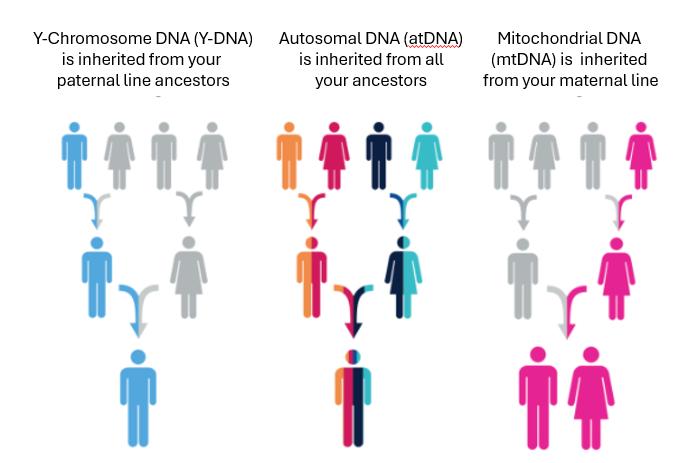
Diagram illustrating how Y‑DNA, autosomal DNA, and mitochondrial DNA are inherited.
mtDNA (Mitochondrial DNA)
The second type of DNA is mtDNA or mitochondrial DNA. This is passed from your mother. This is used to assist in tracing your maternal ancestry and origins – that is your mother, your mother’s mother, your mother’s maternal grandmother, and so on. It can, however, be of limited benefit because it does not change much from one generation to another, so it can be difficult to differentiate a maternal 2nd cousin from a maternal 10th cousin.
Y-DNA (Paternal Line DNA)
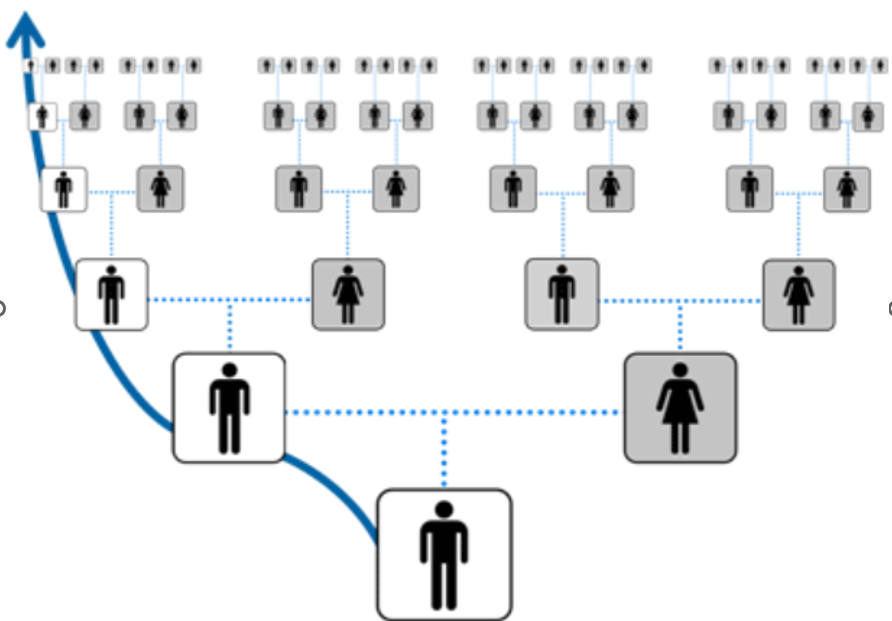
The third type of DNA, Y-DNA, is the genetic material found on the Y chromosome, passed almost unchanged from father to son. Although it mutates slowly, it mutates often enough to enable scientific dating of mutations and approximate dating of shared ancestors.
It is one of the most powerful tools for tracing direct paternal ancestry as it preserves a clear male‑line signature down the generations. Biological males typically have one X and one Y chromosome, while biological females typically have two X chromosomes. Because the Y chromosome is inherited only from the biological father, Y-DNA follows a straight paternal line.
The Burnett Y-DNA Project on Family Tree DNA (Burnett Y-DNA Project - Overview - FamilyTreeDNA) created a virtual laboratory in which we could prove and sometimes disprove our Burnett ancestry. The Y chromosome is stable enough to identify two men who share a common ancestor within the past 1,000 years or more. A more advanced version of the test, called the “Big Y”, can identify mutations shared by testers and date the mutation +/- 80 years, enabling the identification of branches within a paternal line as well as the identification of testers who share a particular branch, much like a branch of a family tree, but specific to about 3 generations instead of a single generation.
The basic Y-37 test provides a top level haplogroup and a list of “matches” – men who share an ancestor with the tester within the past 1,000 years. Men on the list could be a brother, a father, or 1st – nth paternal cousin. Most men find that their matches are distant cousins. If the matches are not too distant, it is often possible to identify their common ancestor by comparing their trees. When a match is more distant, but still within the period where records exist, there is a possibility of extending one’s tree further back in time by identifying how the two men are related. It is also possible with the Y-37 test to distinguish one group of testers from another who have the same top level haplogroup.
The most basic benefit of Y-DNA testing is to enable people not only to identify their own haplogroup but to use their haplogroup to eliminate possible ancestral lines. If you receive a major haplogroup of R-M269 (aka R1b), for example, you automatically know you are not of the same paternal line as a tester whose haplogroup is J-M172 (aka J2) or I-M253 (aka I1). Major haplogroups were formed by mutations that occurred in our ancient ancestors many thousands of years ago. Mutations occurring more recently create minor haplogroups. In the Burnett Y-DNA Project, within each major haplogroup, sub-groups are created representing those related within the past (roughly) 1,000 years. This is beneficial because if you are considering an ancestor as your own, and a proven descendant of that ancestor has tested and does not match your haplogroup and sub-group, it is proof that you do not descend from that ancestor. In this way, you can avoid wasting time on ancestors to whom you are unrelated.
R-M269 and I-M253 are two of the most common haplogroups in the western world and are by far the most common haplogroups for Burnett testers. Haplogroup R1b/R-M269 is the largest in the Burnett Y-DNA Project and has over 25 sub-groups of matching testers. Mutations that form new branches occur, on average, about every three generations. Each minor mutation creates a new haplogroup or branch within your paternal family tree. Using our family trees, in combination with the new branches, we can often identify which ancestor was responsible for a mutation, thereby proving that any tester who possesses that mutation descends from that ancestor. More often, however, we can link a mutation to a range of ancestors – grandfather to grandson. This is still very helpful in extending family trees. If you find your haplogroup, you can see all its branches and ancestor haplogroups using the Discover tool. https://discover.familytreedna.com/ The tool even provides an estimated date when each SNP/haplogroup was created.
As mentioned, the Burnett Y-DNA Project categorizes testers into sub-groups of men who share a common paternal ancestor within the past roughly 1,000 years or less. To identify these groups, the project uses sequence letters. The first R-M269 group was named R-M269A, the second R-M269B and so on. To date, there are 33 sub-groups across the entire project where at least two matching Burnetts were identified, categorized in the chart below.
The Big Y‑700 and Haplogroups
The advanced version of the Y-DNA test, called the Big Y‑700, identifies the “SNPs” (single nucleotide polymorphisms) in the Y chromosome, which are formed when Y-DNA mutates. Y-DNA mutates about every three generations on average. When a mutation occurs, all the descendants of the ancestor whose Y-DNA mutates carry that mutation forward. When two or more men are identified that share the same SNP, the SNP becomes a more refined haplogroup. In this context, the terms SNP and haplogroup are synonymous.
To give readers a sense of how many significant unrelated paternal Burnett lines exist and where they were located and originated, we offer the chart below. The chart lists each significant group within the project by major haplogroup. As discussed, within each major haplogroup, testers are grouped with their matches – those testers who the test has identified share a common ancestor within the past 1,000 years. We describe these as Paternal Sub-groups. The letter preceding the description of each group identifies the sub‑group to which they belong; for instance, Burnett of Barns is sub-group I‑M253C – Group C within the major haplogroup I‑M253.
The age listed refers to the estimated length of time that each is known to have been using the Burnett surname based on historical records and Y-DNA. Many groups have likely been using the name much longer. The age listed refers to the most distant proven age.
Burnett Project Haplogroups / Paternal Sub-groups Chart
| Haplogroup / Age | Description / Most Distant Traced Ancestors | Probable Origin | Tester Residence |
|---|---|---|---|
| I‑M253 / I1 | |||
| 200 years | A. Priscilla (nee Carter) Burnett 1767 and Julius Saunders (NPE) | Unknown | USA |
| 300 years | B. Testers tracing back to Rutherford County NC and Scotland; managed by a separate Y‑DNA Project | Scotland | USA, Australia, Scotland |
| 500 years | C. Burnett of Barns of Burnetland / Peeblesshire | Scotland | NZ, Australia, USA |
| 270 years | E. Moses Burnett 1740–1781 & Rachel Morley of Frederick VA | Unknown | USA |
| 450 years | F. Aberdeenshire lines: Robert Burnett b.1776, Nathaniel Burnett 1730, Robert Burnett & Elspet Booth | Scotland | USA, England |
| I‑P37 | |||
| 300 years | A. Eastern Scotland lines: James Burnett 1810, John Burnett 1704, William Burnett 1776 | Scotland | Scotland |
| J‑M172 / J2 | |||
| 500 years | A. Burnett of Leys, Aberdeenshire | Scotland | Australia, Canada, Scotland, England, NZ |
| 250 years | B. William Burnett b.1774 of Madison County VA; Ramsay testers | Unknown | USA |
| R‑M269 / R1b | |||
| 400 years | A. Largest group; Colonial VA lines (Hanover & New Kent) | Unknown | USA, Canada |
| 210 years | B. Fleming Burnett b.1806, Patrick County VA (NPE) | Unknown | USA |
| 400 years | C. Managed by a separate Y‑DNA Project | Unknown | USA |
| 370 years | D. Scottish Lothians & Ireland lines: Robert Burnett 1655, George Burnet 1665, etc. | Scotland, Ireland | Scotland, Canada, USA |
| 400 years | E. Thomas Burnet & Mary Cooper of Suffolk County NY | Unknown | USA |
| 270 years | F. Robert Burnett 1755–1820 & Susanna Hollingsworth of Fayette OH | Unknown | USA |
| 230 years | G. John Burnett 1794 & Lucretia Evans; John G Burnett 1810 & Letitia Godsey | Unknown | USA |
| 250 years | H. Stephen Burnett 1762–1815 of Robertson TN; Elihu Burnett 1810–1844 | Unknown | USA |
| 270 years | I. John Burnett 1756–1805 & Mary Morgan of Nelson/Ohio County KY | Unknown | USA |
| 350 years | J. William Burnett 1750–1812 Campbell KY; James Burnett 1740–? Prince Edward VA; Peter Burnett 1752 Yorkshire | Unknown | USA |
| 300 years | M. Thomas Burnett 1775 & Rachel of Dutchess NY; Thomas Burnett 1750–1792 of Dumfriesshire | Scotland | USA |
| 200 years | N. Dr. Azariah Burnett of Grainger TN 1817–1862 (probable NPE) | Unknown | USA |
| 300 years | O. Robert Burnett 1759 & Jean Masterson; John Burnett 1760 & Jane of Cumberland | Scotland / England | England, New Zealand |
| 320 years | P. George Burnett 1770 & Elizabeth Adams; James Burnett 1750 & Margaret of Martin NC; Edward Burnett 1844 & Margaret McCluskey | Scotland / Ireland | USA, Scotland, Canada |
| 200 years | R. Descendants of a daughter of Joseph Burnett & Mabel Melton (NPE) | Unknown | USA |
| 280 years | S. Robert Burnett 1741 & Ann Fassett of London & Surrey | England | England |
| 200 years | T. Descendants of Frankie (female) Burnett of Knox/Laurel Kentucky (NPE) | USA | USA |
| 300 years | U. Thomas Burnett 1750 & Mary Quarles of Edgefield SC; James Burnett 1735 of Buckingham VA | USA | USA |
| 250 years | V. Daniel Burnett 1775 & Hannah Gornto of NC; migrated to Georgia & Florida | USA | USA |
| 350 years | W. Jacob Burnett 1670 & Frances of Somerset England | England | England, Canada |
| 320 years | X. Thomas Burnett & Mary Johnston; James Burnett & Mary Nicholson of Orange County NY (early 1700s) | Scotland | USA |
| 300 years | Z. Archibald 1753 & Eunice of Worcester MA and Isaac Burnett 1780 & Deborah Grindle of Washington County ME | Scotland | USA |
Paternal Sub-group Summaries and Research Insights
The Paternal Sub-group summaries provided in these pages are based on a combination of Y-DNA results, family trees provided by testers, family trees built by project administrators, and historical research. When new testers join the Burnett Y-DNA Project, they share their family tree. While we await the results, we validate the tree they have provided to the extent possible using historical records.
The summaries include the names of the ancestors of our testers, including their wives where known. Names of recent ancestors are omitted for tester privacy reasons. Most of the ancestors listed herein have been validated, but in some cases the records to prove or disprove an ancestor do not exist or could not be found, and a combination of Y-DNA results and indirect evidence has been used for validation.
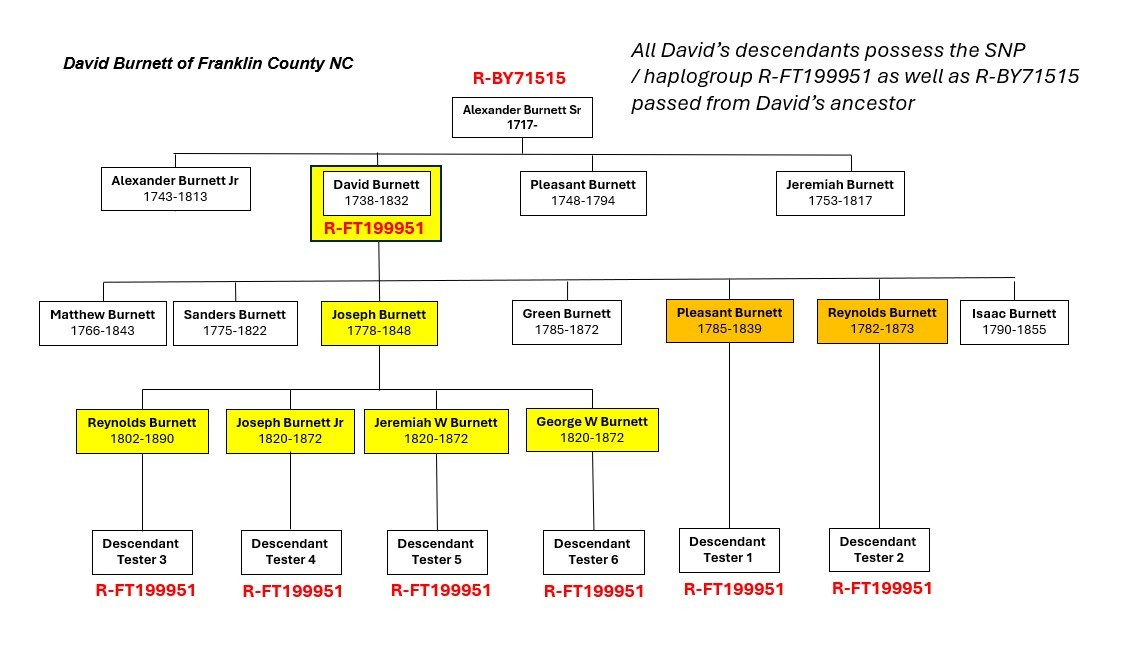
As an example of the insight Y-DNA can provide, we offer David Burnett (ca. 1738–1832) of Franklin County, North Carolina. Prior to the Burnett Y-DNA Project, he was little known and little researched. As it turns out, David has a very prolific group of descendants. Results from two testers revealed a haplogroup of R‑FT199951. One tester descends from Reynolds Burnett and the other from Pleasant Burnett, who were then traced using historical records to their father David Burnett.
Big Y results from three other testers revealed the same haplogroup but could not readily be traced to David. Descendants had been searching for years to identify the parents of Jeremiah W. Burnett, George W., and Joseph Burnett shown below.
An exhaustive search using historical records in combination with autosomal DNA finally identified an additional son of David, Joseph Burnett. Joseph was named as a son of David in a probate record but had not been found in any other records. Without the Y-DNA evidence linking these men to David, we would not have known to look for another son of David as the ancestor of these testers. We now also have test results from Joseph’s son, Reynolds Burnett.
Linking SNPs to Specific Ancestors
As in the example above, we can sometimes link an SNP to a specific ancestor. When this occurs, any tester who possesses that SNP can be proven to descend from that ancestor. We have several examples of this within the Burnett Y-DNA Project.
Unfortunately, there are no guarantees that a Y-DNA test will lead to new discoveries. In some cases, testers find that one of their ancestors was not fathered by a Burnett at all. This is what is called a non-paternal event (NPE). This happens when there is an adoption, when a man changes his name, or when there is a birth out of wedlock and a son does not take the name of his biological father. When this happens, testers will see a list of matches who have a surname other than their own.
By contrast, we also have testers whose surname is not Burnett, but who are proven through Y-DNA testing to have descended from a Burnett paternal line, presumably as the result of an NPE. Through the testing, in combination with historical records, we can sometimes identify the biological father and when the NPE occurred. Several such cases are documented in these summaries.
How to Use the Summaries
Each Paternal Sub-group summary contains the names of all the validated ancestors of our testers, along with key vital information such as birth and death year and location and the name of their spouse. A separate composite list of the surnames in all the sub-group summaries is also provided. This is all aimed both at those who have already tested, to enable them to expand their knowledge about their Burnett line and to see the broad positive impact of their testing; and at those male Burnetts who have not yet tested, as well as those who are not male or who are researching a non-paternal Burnett line.
You will not find your father nor (probably) your grandfather, as we have excluded recent ancestors for privacy reasons. To search for your ancestors, start with the most distant paternal Burnett ancestor you have proven in your family tree. You may use keyword search to find your ancestor. If your ancestor does not have a common first name, you may find them easily using a simple name search (Ctrl F). Since there are so many ancestors named John, William, James, etc., it may be best to start by searching the name of their spouse or birth or death county or year if you know it.
If you identify your ancestors in these summaries, we hope you find the research we have provided helpful, and will make a donation to help fund further research and to keep this website running and updated. If you do not find your ancestor, it is possible we have not yet tested your line, or perhaps we have not yet tested your branch. In either case, we encourage you to take a Y-DNA test if you are a male Burnett, or to recruit a surrogate tester from your Burnett line if you are a female.
The Burnett Surname and the Link to Scotland
Most descendants of this name spell the name as Burnett. However, the single‑T spelling, Burnet, and the added “e”, Burnette, are also frequently seen. Observing earlier records of this surname, it is clear the single‑T was used more frequently in the 1600s and early 1700s, with most adopting the double‑T after that. The “e” at the end seems to have become popular mostly in the USA and not until the late 1800s for the most part. The variations do not appear to be a result of different Burnett families, but more of personal preference or of a clerk or family member who spelled it how he or she chose. In Scotland, the name is pronounced “Burn‑it”.
To date, Y-DNA testing has not revealed any linkage to the Barnett surname. And although it is well documented that the Burnett name, as used by Burnett of Leys, evolved from Burnard, to date the project has not identified any Y-DNA matches to men of the surname Burnard or Bernard.
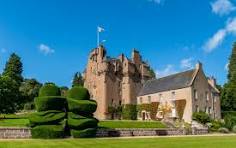
Y-DNA has shown that there are multiple distinct Burnett family lines. Many of them have been traced to Scotland, but most do not lead back on a direct paternal line to the known noble Scottish heritage such as the Burnetts of Leys or the Burnetts of Barns. However, all Burnetts can regard themselves as belonging to one big Burnett family. Crathes Castle near Banchory, Aberdeenshire, the family seat of the Burnetts of Leys, is our cultural and spiritual home.
Surnames came into use about 1,000 years ago. At the time, people commonly adopted their town as a surname or their Lord/Laird’s surname. This is how some of our Burnett ancestors may have acquired the name, through connection to these ancient houses. And, of course, some Burnetts may connect to the Leys or the Barns through the maternal Burnett line as a result of a non‑paternal event. Conversely, we have an example of a man whose surname is Bruce whose earlier paternal lineage is shown through Y-DNA to have been a Burnett. In addition, we have an example of a Burnett who married into the Ramsay family and changed his name to Ramsay in order to inherit his wife’s estate.
Questions, Comments, and Corrections
Questions, comments, and corrections can be submitted to:
Lawrence Pearse — lawrencepearse@msn.com
Terry Barwin — terrybarwin@gmail.com